
Table of Contents
- What Makes a Cleansing Facial Oil Different From Soap
- How to Use Cleansing Oil Without Leaving Residue
- The Double Cleansing Method Explained
- Oil Cleansing for Acne-Prone Skin: What Actually Works
- Choosing a Cleansing Facial Oil for Dry, Sensitive, or Mature Skin
- Troubleshooting Reactions and Environmental Impact
- Conclusion
- Frequently Asked Questions
Last Updated: September 18, 2026
What Makes a Cleansing Facial Oil Different From Soap
A cleansing facial oil is a lipid-based cleanser that dissolves makeup, sunscreen, and excess sebum without stripping the skin barrier. Soap and foaming gels rely on surfactants that lift oil by force, often pulling natural moisture with it. Oil cleansers work the opposite way: like dissolves like.
At glō Luxury Oils, we build every cleansing facial oil around that principle. The difference shows up fast. Traditional cleansers can leave skin tight and reactive, especially in dry air where your barrier is already under pressure. A well-formulated cleansing facial oil removes the day's buildup while leaving lipids intact.
The catch is technique. Oil alone doesn't rinse clean; it needs an emulsifier to turn milky and wash away.
How to Use Cleansing Oil Without Leaving Residue
Residue almost always comes down to two things: not enough massage time, and not enough water at the rinse stage. Fix both and the film disappears.
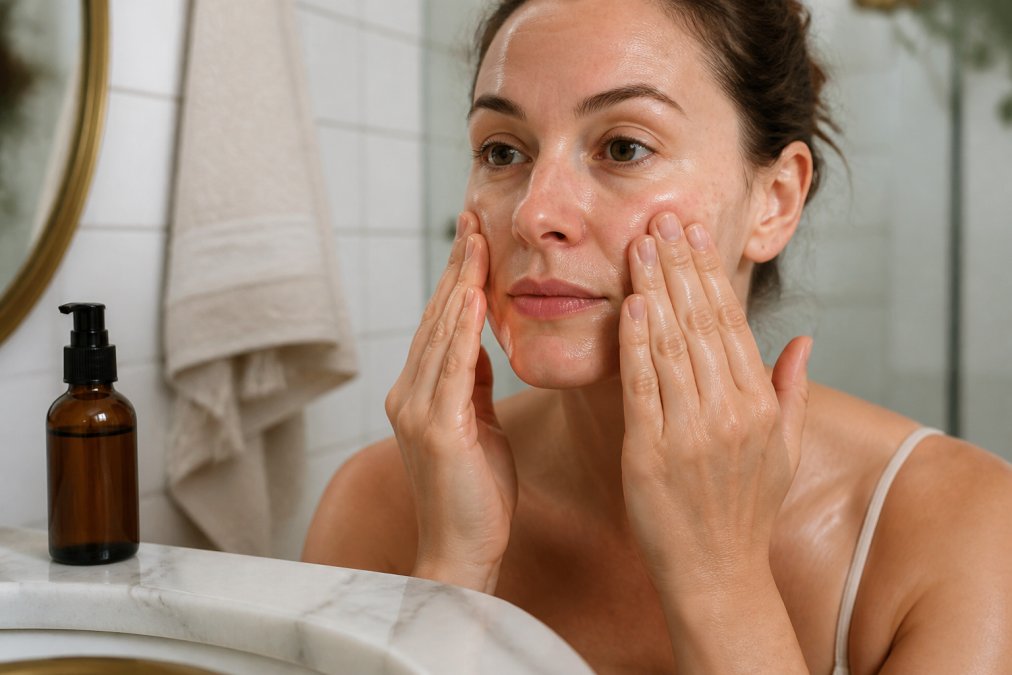
Massage Technique and Emulsification
Emulsification is the process where an emulsifier bonds with oil and water so the mixture rinses away instead of sitting on your skin. Most modern cleansing facial oils include one. Your job is to give it water and friction.
Rinse-Off and Skin Barrier Protection
Rinse with lukewarm water, never hot. Hot water strips the skin barrier and undoes the point of using oil in the first place. Follow with a gentle second cleanse if you wore heavy sunscreen, then moisturize while skin is still damp.
The Double Cleansing Method Explained
The double cleansing method means washing first with an oil-based cleanser, then with a water-based one. The oil phase breaks down waterproof makeup, sunscreen, and sebum. The water phase clears sweat, dust, and any remaining residue. That much is standard advice. What most guides skip is the chemistry that makes the first step actually work, and why skipping it leaves a film no second cleanser can fully remove.
The Emulsification Science Behind a Clean Rinse
Oil and water do not mix on their own. A pure carrier oil will dissolve makeup and sunscreen beautifully, then refuse to leave your face. That is why every well-formulated cleansing oil contains an emulsifier, a surfactant molecule with one end that loves oil and one end that loves water.
Step-by-Step Routine for Arid Climates
- Apply cleansing facial oil to dry skin, massage 45-60 seconds
- Add water, massage until the oil turns milky
- Rinse with lukewarm water
- Follow with a mild, pH-balanced water-based cleanser
- Pat dry and moisturize within 60 seconds
| Step | Product Type | Time | Purpose |
|---|---|---|---|
| First cleanse | Cleansing facial oil | 60 sec | Dissolves makeup, SPF, sebum |
| Emulsify | Water + massage | 15 sec | Turns oil milky, rinse-ready |
| Second cleanse | Gentle water-based gel | 30 sec | Clears sweat and residue |
| Moisturize | Facial oil or cream | 30 sec | Seals hydration |
Why the Second Cleanse Still Matters
If your cleansing oil emulsifies fully, you might wonder why a second cleanse is needed at all. The answer is what the oil phase cannot reach. Oil dissolves oil-soluble debris, makeup pigments, sunscreen filters, oxidized sebum. It does not dissolve sweat, which is water-based, or the fine dust and pollution particles that cling to the skin's surface. A gentle water-based second cleanse clears those, and it also removes any emulsifier residue left behind if your rinse was rushed.
When to Skip the Second Cleanse
Double cleansing is not a daily requirement for everyone. If you have dry or reactive skin and did not wear heavy sunscreen or makeup that day, a single well-emulsified oil cleanse followed by moisturizer is often enough. The second cleanse is most valuable on days with SPF, long-wear makeup, or heavy environmental exposure. Over-cleansing strips the barrier just as surely as under-cleansing congests it.
Oil Cleansing for Acne-Prone Skin: What Actually Works
Oil cleansing for acne-prone skin works when the oils you choose are low on the comedogenic scale, high in linoleic acid, and paired with an emulsifier that actually rinses clean. The wrong base oil can clog pores; the right one helps regulate sebum. Most articles stop at "use non-comedogenic oil" and never explain why the same oil can clear one person and break out another.
Why Linoleic Acid Matters More Than the Label
Sebum is not one substance. It is a mix of triglycerides, wax esters, squalane, and free fatty acids, and its fatty-acid profile shifts with your skin. Acne-prone skin tends to produce sebum that is lower in linoleic acid (an omega-6 fatty acid) and higher in oleic acid (an omega-9). Oleic acid is thicker and more prone to forming the sticky, oxidized plug that starts a comedone.
Comedogenic Ratings of Common Carrier Oils
Comedogenic ratings run from 0 to 5, where 0 means unlikely to clog pores and 5 means highly likely. The scale comes from rabbit-ear testing, which is imperfect for human faces, so treat it as a starting filter, not a verdict. A common pattern is that oils rated 0-2 suit most acne-prone users, oils rated 3 are a coin flip, and oils rated 4-5 are best avoided on the face.
| Carrier Oil | Comedogenic Rating | Dominant Fatty Acid | Notes for Acne-Prone Skin |
|---|---|---|---|
| Hemp seed | 0 | Linoleic | Lightest feel, high linoleic, good first pick |
| Sunflower seed | 0 | Linoleic | Cheap, gentle, often the base of choice |
| Safflower | 0 | Linoleic | Good for congested, oily skin |
| Grapeseed | 1 | Linoleic | Astringent feel, popular in acne blends |
| Rosehip | 1 | Linoleic | Antioxidant-rich, can feel dry on some skin |
| Jojoba | 0-2 | Wax ester | Closest to human sebum, well tolerated |
| Sweet almond | 2 | Oleic | Richer, better for normal-to-dry skin |
| Avocado | 2-3 | Oleic | Heavy, better for dry or mature skin |
| Olive | 2 | Oleic | Can feel occlusive on oily skin |
| Coconut | 4 | Lauric | Best avoided on acne-prone faces |
| Wheat germ | 5 | Linoleic | Too heavy for facial use |
What to Look For in a Formula
Look for non-comedogenic blends built on linoleic-dominant carrier oils, with added antioxidants (vitamin E, green tea extract) and botanical extracts rather than single heavy oils. A well-built acne-friendly cleansing oil usually lists a light carrier oil first, a plant-derived emulsifier second, and any active botanicals last. If coconut oil, wheat germ oil, or a heavy fragrance appears in the first five ingredients, that is a signal to look elsewhere.
Choosing a Cleansing Facial Oil for Dry, Sensitive, or Mature Skin
Match the oil blend to your skin type, not the trend. Dry skin wants richer fatty acids; sensitive skin wants minimal ingredients; mature skin benefits from oils with nourishing and regenerative properties.
Troubleshooting Reactions and Environmental Impact
Most reactions to cleansing facial oil trace back to one of three causes: an irritating fragrance, a comedogenic base oil, or leftover residue from poor rinsing. If you develop small bumps, switch to a fragrance-free blend and cut back to once daily.
Conclusion
Getting cleansing facial oil right comes down to technique and ingredient choice, not price. If your skin is dry, reactive, or simply tired of tight, stripped-feeling cleanses, the fix is a low-comedogenic oil, proper emulsification, and a rinse that respects your barrier.
Frequently Asked Questions
Is a cleansing oil good for your face?
A cleansing facial oil works well for most skin types because it dissolves lipid-soluble debris like waterproof makeup, sunscreen, and sebum without stripping the skin barrier. Unlike foaming cleansers that can leave skin tight and dehydrated, oil-based cleansers rinse off clean when they contain surfactants that emulsify on contact with water. People with dry, sensitive, or mature skin often see the biggest difference, since the formula supports hydration rather than removing it.
Do I use cleansing oil before or after I wash my face?
Use cleansing oil first, as the opening step of the double cleansing method. Massage it onto dry skin to break down makeup and sunscreen, add water to emulsify, then rinse. Follow with a gentle water-based cleanser if you want a deeper clean. Reversing the order means the oil sits on top of cleanser residue instead of lifting it, which can leave a film and contribute to pore congestion over time.
Can cleansing oil cause breakouts?
It can if the formula relies on highly comedogenic carrier oils or if you skip emulsification and leave residue behind. Look for non-comedogenic oils with a low comedogenic rating, plus surfactants that let the product rinse off fully. Oil cleansing for acne-prone skin works when the formula is chosen carefully and massaged for 60 seconds, then removed completely. If you are testing a new cleansing facial oil, patch test on your jawline for a week first.
How do you properly emulsify a cleansing oil?
Emulsification happens when you add a small splash of lukewarm water to your oiled hands and keep massaging. The surfactants in the formula bind to the oil and water, turning the texture milky white. Once it looks like thin milk rather than clear oil, you have emulsified it. Rinse with lukewarm water until the milky residue is gone. Skipping this step is the most common reason people feel greasy after oil cleansing.